UK Progress Atlas

Research & Innovation

UK Pre-clinical Translational Models Hub — Cambridge

The UK Pre-clinical Translational Models Hub is a funded research programme based at the Cambridge Stem Cell Institute. It brings laboratory models of human disease together with artificial intelligence, clinical samples and expertise from universities, NHS organisations and industry. The hub launched in November 2026, with a formal event scheduled for 27 November.[1][2]

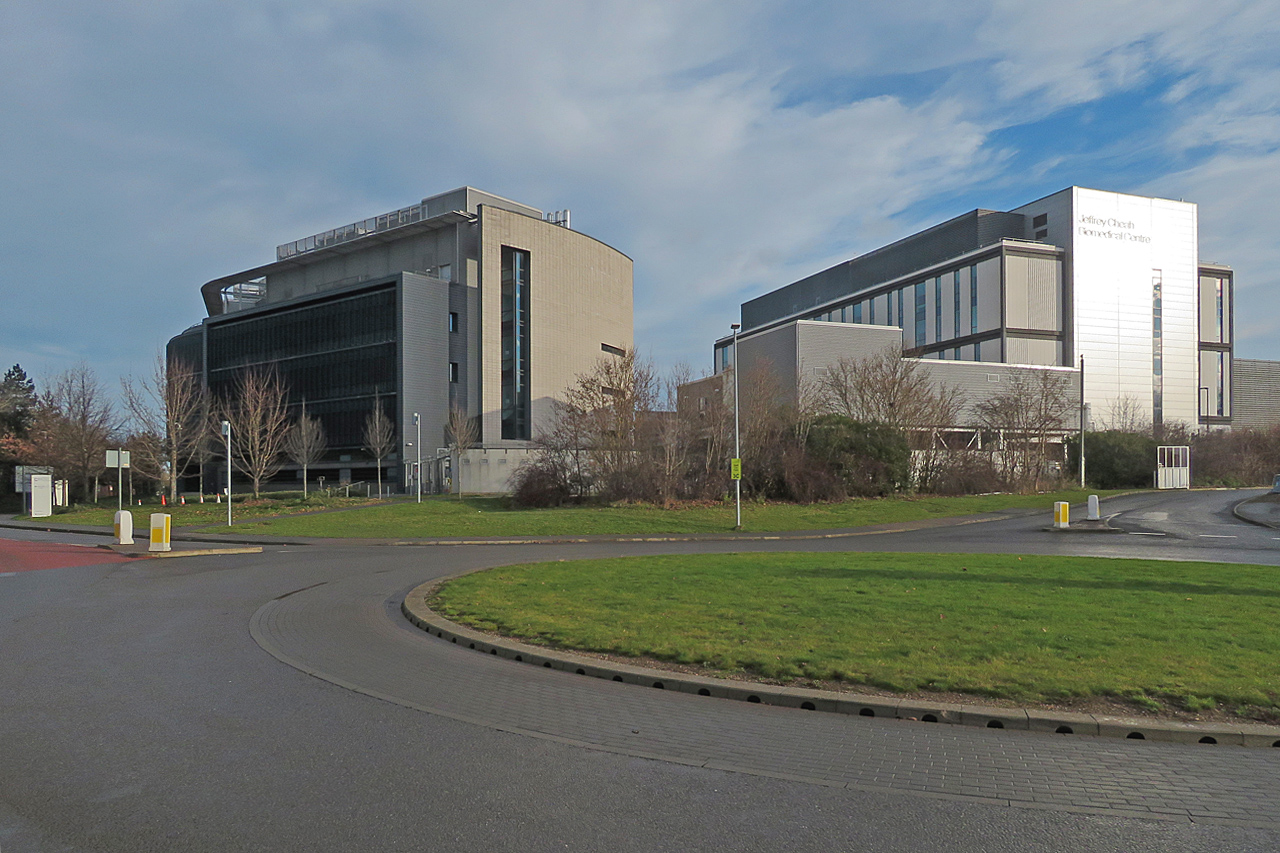
Jeffrey Cheah Biomedical Centre and neighbouring research buildings, January 2022
Photo creditJohn Sutton / Geograph Britain and Ireland; display may crop · CC BY-SA 2.0 · Original image

Research capability

The programme will evaluate and validate laboratory models of human disease, including organoids and other cell-based approaches. Teams will work on reproducibility, comparison with patient data and methods that other research organisations can use. UKRI's funding framework provides for expanded host-site capability, shared technology and external users. The hub operates from existing facilities in the Jeffrey Cheah Biomedical Centre.

People and partnerships

Professors Matthias Zilbauer and Bertie Göttgens lead the hub. Partners include the Wellcome Sanger Institute, MRC Laboratory of Molecular Biology, Cambridge University Hospitals and Royal Papworth Hospital. Its national network links research, clinical and commercial expertise beyond Cambridge.

Funding and delivery

The MRC awarded £20 million to establish the core institute. A 2 November ministerial answer distinguishes that award from the remaining funding for wider translational networks in the original £30 million programme allocation. These figures describe research funding. The next phase is to develop, benchmark and validate models and support their adoption by clinical and industrial researchers.

Why it matters

Human-based models can preserve features of individual diseases that are difficult to reproduce in animals. The hub's purpose is to turn those models into tools that can be used reliably across medicines research. Better prediction and reduced animal use are intended research outcomes; benefits will be measured as the programme develops.

Map information

Representative host building pin for the Jeffrey Cheah Biomedical Centre. [3][4]

Timeline

12 August 2026
Medical Research Council core award announced.[5]

2 November 2026
Minister distinguishes the £20 million institute award from wider network funding.[6]

November 2026
Research hub launched.

27 November 2026
Formal launch event scheduled.

Latest developments

Research & Innovation · 27 November 2026

Cambridge launches £20m hub for human-based drug research

A national research hub led from Cambridge has launched to help scientists test potential medicines using laboratory models of human disease. The UK Pre-clinical Translational Models Hub launched in November following a £20 million Medical Research Council award announced in August. Its formal launch event is scheduled for 27 November.

Based at the Cambridge Stem Cell Institute, the hub connects universities, NHS partners and industry, including the Wellcome Sanger Institute and MRC Laboratory of Molecular Biology. Its work combines patient-derived organoids — simplified models grown from human cells — with other cell systems and artificial intelligence. The aim is to make these techniques more reproducible and useful across drug research.

The programme will develop and validate models, compare them with clinical evidence and widen access for research teams. This could help identify promising treatments earlier and reduce reliance on animal experiments as human-based methods become established.

Sources
  1. gov.uk ↗
  2. cam.ac.uk ↗
  3. stemcells.cam.ac.uk ↗
  4. mapcarta.com ↗
  5. stemcells.cam.ac.uk ↗
  6. qna.files.parliament.uk ↗
  7. stemcells.cam.ac.uk ↗
  8. cuh.nhs.uk ↗
  9. ukri.org ↗
  10. stemcells.cam.ac.uk ↗